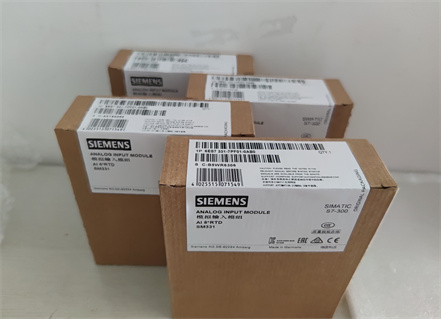
In critical surge arrester monitoring systems, real-time, precise detection of internal temperature changes is a core component in preventing catastrophic thermal runaway failures. This is precisely the core rationale behind our strong recommendation to adopt the Siemens 6ES7331-7PF01-0AB0 analogue input module. Designed for harsh industrial environments, this module plays an indispensable role as a high-reliability temperature monitoring terminal in the surge arrester overheating risk detection system. Its core value is reflected in the following key dimensions:
Precise risk detection: Industrial-grade RTD measurement capability: Aging of internal valve plates or sustained overvoltage in surge arresters can lead to resistance degradation and abnormal temperature rises. The core advantage of the 6ES7331-7PF01-0AB0 module lies in its exceptional industrial-grade RTD (platinum resistance temperature detector) measurement capability. It can precisely capture millivolt-level signal changes from RTD sensors connected to surge arrester hotspots and convert them into digital values with high precision. This ability to sensitively detect subtle temperature anomalies is a critical technological safeguard for identifying signs of surge arrester overheating, enabling predictive maintenance, and preventing sudden failures during operation (such as thermal breakdown).
Resistance to extreme environments: Electrical isolation and anti-interference design: When surge arresters perform their functions (discharging lightning currents or handling overvoltages), the surrounding environment is instantly filled with extremely strong electromagnetic fields and elevated ground potentials. The 6ES7331-7PF01-0AB0 module is equipped with robust electrical isolation functionality and optimised anti-interference design (such as high-level EMC protection and filtering circuits). This design enables it to effectively withstand strong electromagnetic impacts (EMI) and transient overvoltages caused by lightning strikes or switching operations, ensuring that temperature monitoring signals remain clear, stable, and distortion-free under extreme disturbance conditions, thereby guaranteeing the continuity and reliability of monitoring data.
Seamless Integration into the Safety Chain: Trusted Data Source and Safety Integration: Modern power system safety protection often requires achieving high safety integrity levels (e.g., SIL). The 6ES7331-7PF01-0AB0 module, as a key component of the signal acquisition layer, ensures high-precision, interference-resistant characteristics, providing highly reliable, low-noise, low-drift temperature data sources for upper-level safety control systems (such as Siemens S7-400FH or S7-1500F/FH series controllers compliant with SIL3 standards). These reliable data form the basis for safety controllers to make logical decisions (such as over-temperature alarms or tripping) and are an indispensable and trustworthy input component in the entire safety instrumented system (SIS) or protection loop.
Optimised configuration recommendations:
For applications requiring extremely high availability or higher safety levels (such as SIL2/SIL3), the system architecture can be further optimised:
Redundancy solution: Deploy redundant 6ES7331-7PF01-0AB0 modules, connecting them to different temperature measurement points of the same lightning arrester or redundant RTDs at the same temperature measurement point. The controller compares and votes on the data, significantly enhancing the availability and fault tolerance of the monitoring channels.
Safety level enhancement: If the system as a whole needs to meet SIL3 requirements, the signals collected by the 6ES7331-7PF01-0AB0 can be connected to Siemens fail-safe analogue input modules, such as the F-AI 6ES7336-4GE00-0AB0 (for S7-300F) or the corresponding S7-1500F series safety I/O modules. These modules incorporate additional diagnostic functions (such as open-circuit detection, short-circuit detection, out-of-range detection, and cross-channel comparison) and safe internal processing logic. They convert the raw signals into data with ‘safety status’ information that complies with safety communication protocols (such as PROFIsafe), significantly expanding the system's safety diagnostic coverage and fault tolerance capabilities, providing robust protection for the most stringent safety applications.
 Address: WING INDUSTRY BLDG 3, TSUN WEN ROAD, TUEN MUN NT, HONG KONG
 Tel: +86 19116398948
 Email: sh_plc@163.com
 Contact: Vivi Wong